
Background & results
Quality data was scattered and duplicated: IQC, IPQC and FQC each used their own forms with no common format, lot, work-order and part numbers were transcribed or keyed repeatedly, and one batch’s inspection, nonconformance, rework and scrap records sat apart — slow to trace and easy to lose.
Nonconformances did not travel: an NG meant filling in a separate form on paper or in Excel, defect photos stayed on a phone unlinked to the inspection record, and escalation happened verbally or over chat with nothing formally logged.
Rework and scrap were managed separately with no full lifecycle: rework items were not linked to the original NG record, scrap reasons and quantities were re-entered, and the path from NG through disposition to re-inspection was never visible end to end.
Every report was compiled by hand: monthly summaries, nonconformance statistics and supplier assessments were calculated manually, and NG, rework and scrap rates could not be produced on demand for management.
Inspection standards were posted on paper, so stations could be working to different revisions with no way to guarantee updates reached them all — new staff risked inspecting to a superseded standard.
The workflow leaned on people: results were hand-written then keyed into Excel, staff switched between paper, phone and PC, and whether a reworked item had been re-inspected was tracked manually and easily missed.
There was no live view and no cross-batch comparison: daily inspection volume, NG ratio and defect distribution were invisible, and there was no way to check whether the same part failed consistently across IQC, IPQC and FQC — so improvement rested on experience.
SCOPE
Pending batches looked up from receipts; the digital form supports saving in progress, logging nonconformances and uploading photos, then routes to put-away or nonconformance handling
Select the operation by work order or part number, see the in-process list, and record readings, disposition and notes
Search pending batches by customer, date range or put-away document, and record finished-goods items, measured values and dispositions
Rework and scrap dialogs capture reason and outcome, closing the loop from NG through disposition to re-inspection
Rework and scrap detail searchable by date, supplier, part number and result; two-way ERP–MES integration
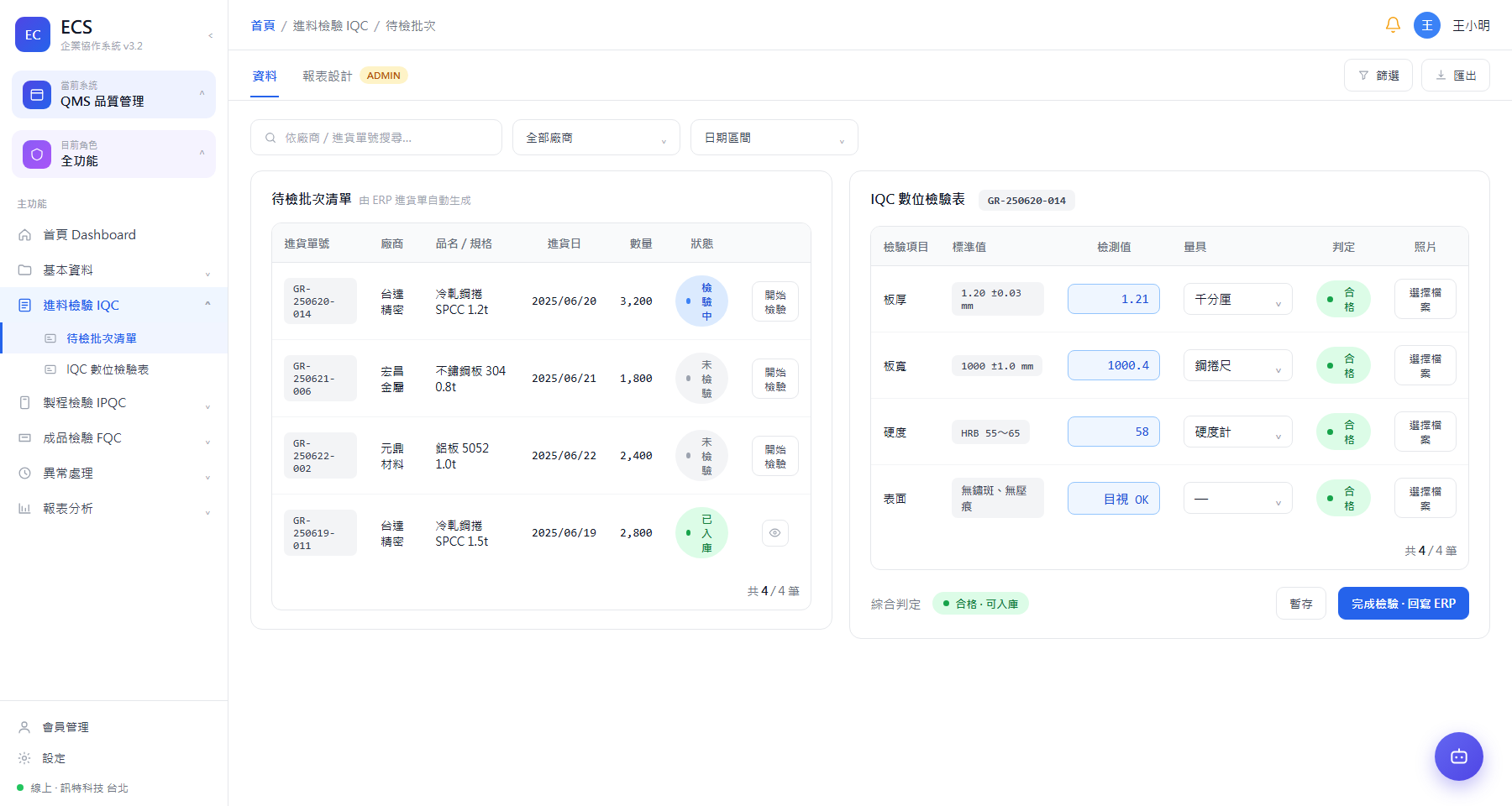
Pending batches should surface themselves
Receipts can be searched by vendor, date range, document type and number; the system lists everything not yet inspected or mid-inspection, and “start inspection” opens the digital form with save-in-progress, nonconformance logging and photo upload — on completion the batch status updates and routes to put-away or nonconformance handling.
IQC receiving inspection (pending batch list) + digital inspection form
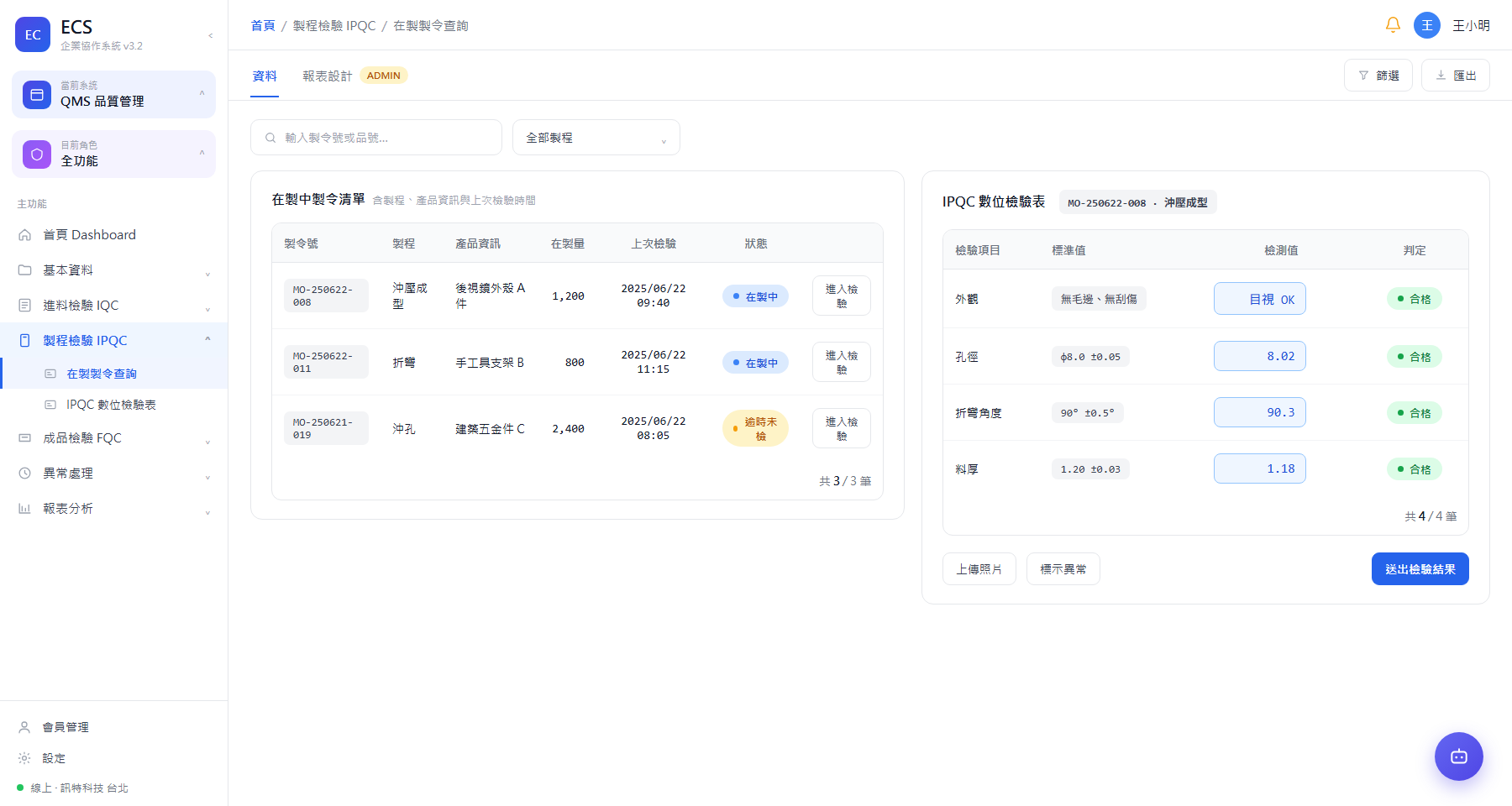
Know when this work order was last checked, mid-process
Search by work order or part number and pick the operation to see in-process orders with their operation, product data and last inspection time; the inspection screen captures readings, disposition and notes with live entry, photo upload and nonconformance flagging.
IPQC (in-process work-order lookup) + digital inspection form
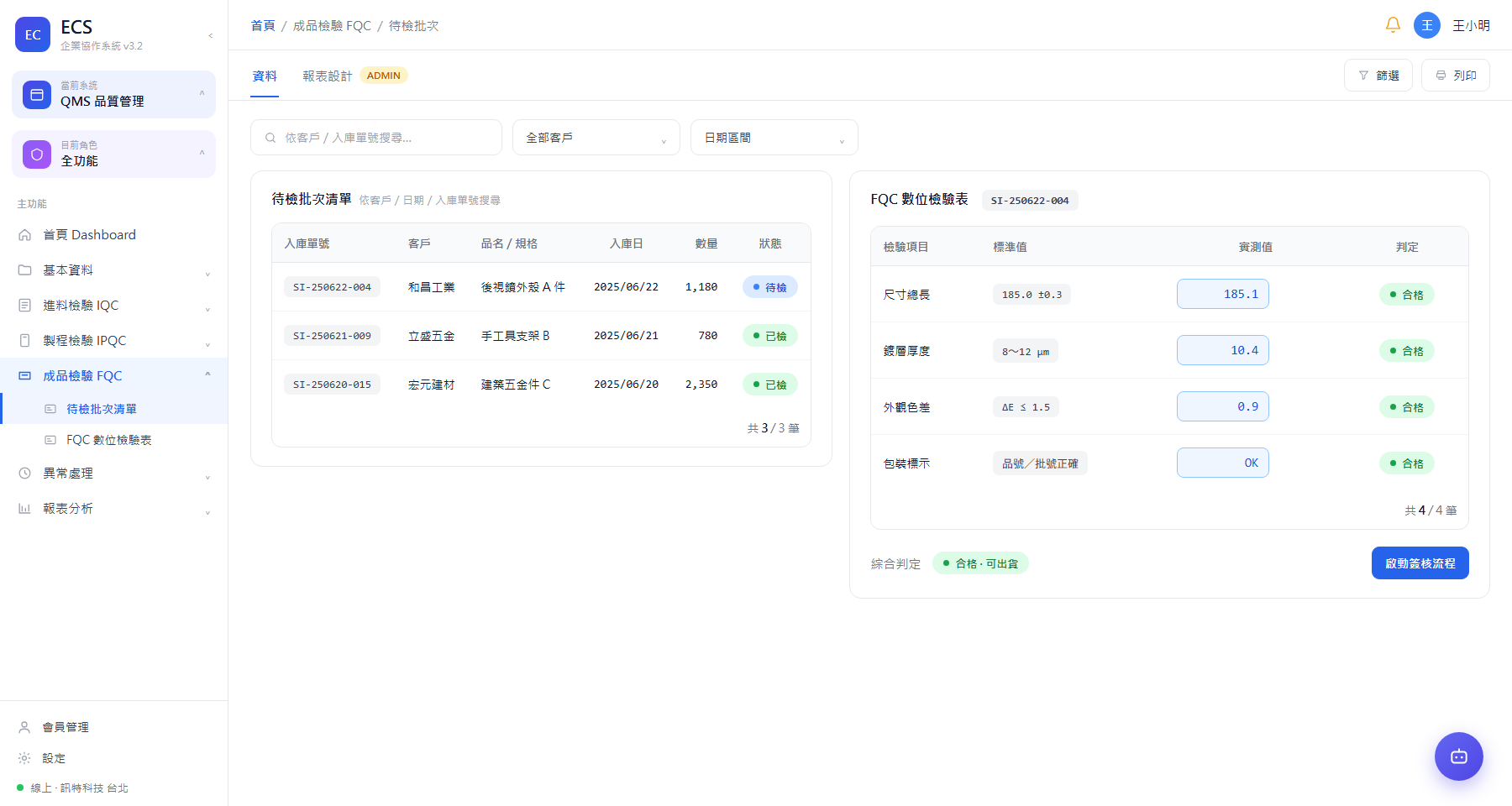
Find the final check by customer or put-away document
Pending batches can be searched by customer, date range or put-away document number; the inspection screen captures finished-goods items, measured values, disposition and notes, with live nonconformance flagging and photo upload.
FQC finished-goods inspection (pending batch list) + digital inspection form
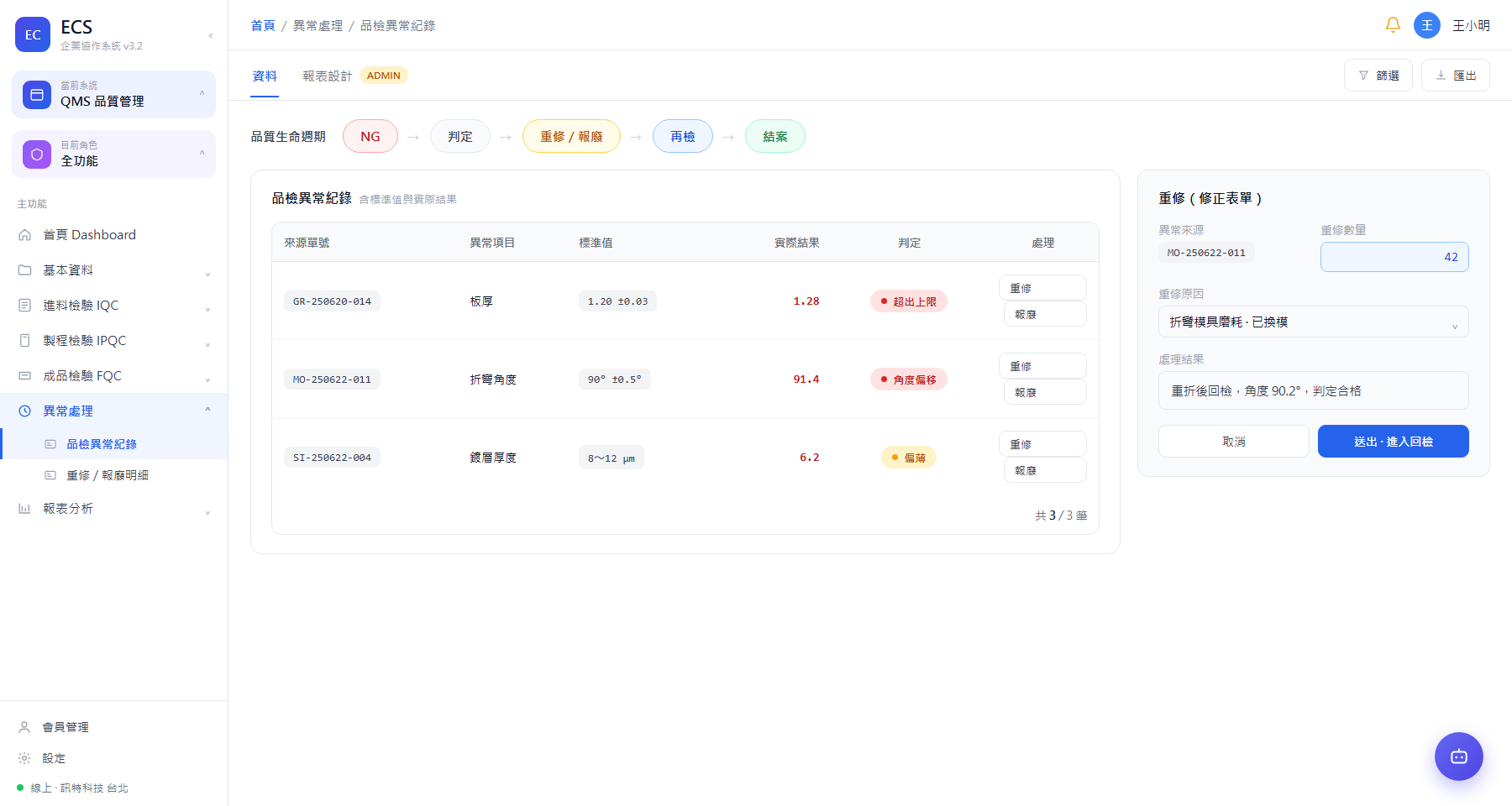
An NG has to run to completion, not stop on a slip of paper
Every failed item is shown together with its standard and actual value; clicking rework or scrap opens the matching dialog to capture reason and outcome, closing the loop from NG through disposition and rework or scrap to re-inspection.
Nonconformance record + rework form + scrap form
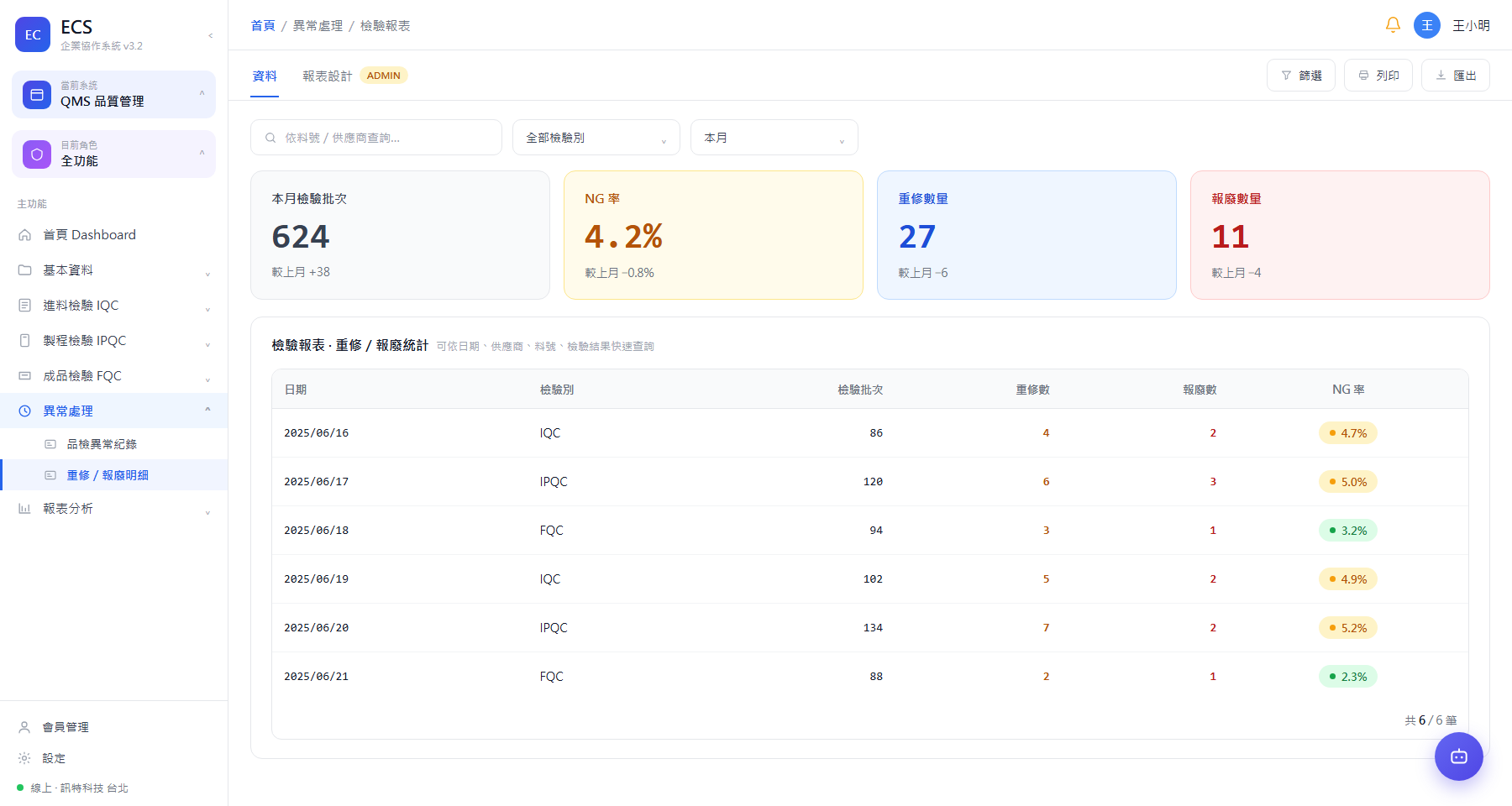
How much was reworked and scrapped — countable on the spot
Each inspection record is flagged for rework or scrap and the quantities are totalled automatically for live statistics; the detail can be searched by date, supplier, part number and result.
Inspection report (rework / scrap statistics) + rework and scrap detail
RESULTS
- Inspection data, nonconformance records and quality indicators are compiled live, so management can read process quality and defect trends at once instead of waiting on hand-built reports.
- The full path from inspection through nonconformance and rework or scrap to re-inspection is traceable, with source, disposition and resolution retained for accountability and improvement analysis.
- Standards are digital and the current revision loads straight into the inspection screen, so no station works to an outdated version — cutting misinspection risk and shortening training.
- Quality, production, purchasing and warehousing work from one source, so defects feed straight back to the responsible operation and supplier — less talking, faster resolution.
- Accumulated NG, rework and scrap rates and defect distributions give supplier assessment and process improvement a quantitative basis — shifting quality work from judgement to data.
- With quality data already flowing consistently to and from ERP, the ground is laid for SPC, tooling management, maintenance and quality dashboards.